

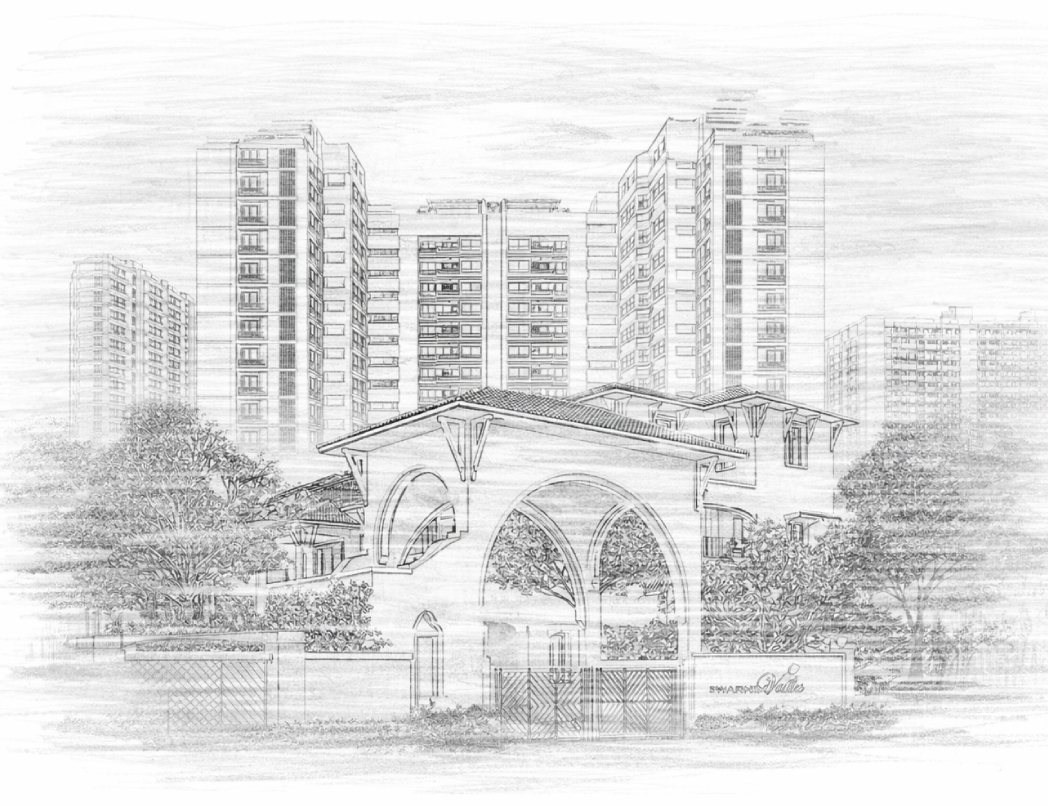

If you're deciding between a 3 BHK and 4 BHK in Ahmedabad, go with three bedrooms unless your family has a specific, daily reason to use that fourth room. The smaller configuration costs ₹15,000-28,000 less per month in EMI, finds a buyer faster whenever you want to resell, and a family of four or five fits into it without anyone feeling cramped.
That advice won't apply to everyone, obviously. Your parents might be moving in with you next monsoon. Or both you and your spouse might be working from home full-time, Zoom calls overlapping, kids running around, and a single spare room won't cut it. Those are real situations where the fourth bedroom pays for itself. But you need to know what that fourth bedroom actually costs you over 20 years of loan repayment, and how the resale market treats each size, before you commit. All of that is below.
Key Takeaways
- Three-bedroom apartments take the largest share of new launches and resale deals in Ahmedabad right now.
- Picking the bigger flat adds ₹15,000-28,000/month to your EMI at current home loan rates (7.25%-7.75%).
- Three-bedroom units move faster on resale because the buyer pool is wider.
- Four bedrooms make financial sense mainly for joint families, dual full-time WFH households, or families with three or more kids.
How Much More Does a 4 BHK Cost in Ahmedabad?
In the same project, expect the four-bedroom variant to cost 35-55% more. What does that look like in actual rupees?
Over in the Adalaj-Zundal belt, rates run about ₹3,800/sq ft. A three-bedroom flat at Swarnim Skyline starts at 2,421 sq ft. The four-bedroom option in the same project goes up to 3,474 sq ft. That's over a thousand extra square feet on the agreement, and every one of those square feet costs money. On S.G. Highway, where rates range from ₹6,050 to ₹9,100 per sq ft, the rupee gap between configurations gets even wider.
City-wide, three-bedroom apartments range from about ₹60 lakh in areas like Adalaj and Chandkheda to ₹1.5 crore along S.G. Highway and Prahlad Nagar. Four-bedroom options start around ₹1 crore and climb past ₹2.5 crore depending on the builder and location.
| Factor | 3 BHK | 4 BHK |
|---|---|---|
| Typical carpet area | 1,200 - 1,800 sq ft | 1,800 - 2,800 sq ft |
| Price range (Ahmedabad) | ₹60L - ₹1.5Cr | ₹1Cr - ₹2.5Cr |
| Monthly maintenance (approx.) | ₹3,000 - ₹5,500 | ₹4,500 - ₹8,000 |
| Stamp duty at 4.9% on ₹80L vs ₹1.2Cr | ~₹3.92L | ~₹5.88L |
Most people forget about stamp duty when comparing. On these example figures, the bigger flat costs almost ₹2 lakh more in stamp duty alone. That money is gone the day you register at the sub-registrar's office. It doesn't grow, you can't get it back, and no EMI calculator includes it.
What Extra Space Does the Fourth Bedroom Actually Give You?
Depends on the builder, honestly. We've seen floor plans where the "fourth bedroom" is 80-90 sq ft, barely large enough for a single bed and a small side table. Other projects give you 150-200 sq ft for that room, with an attached bath and a wardrobe wall. One is a storage room you can technically sleep in. The other is a real bedroom. Big difference, and you can't tell which one you're getting from a brochure thumbnail.
At Swarnim Skyline, for example, the four-bedroom layout at 3,474 sq ft has a proper fourth room with its own bathroom. Separate living and dining areas (not the open-plan compromise you see in smaller flats), plus a utility balcony. The three-bedroom at 2,421 sq ft in the same project gives you three rooms with attached baths, an open living-dining space, and a kitchen with a utility section. It's a comfortable flat for a family of four. The bigger layout just adds one more room for guests, for an office, or for a teenager who's done sharing with a sibling.
Running costs are where the difference sneaks up on you. An extra room means one more AC running through peak Ahmedabad summer (April to June, when electricity bills are already painful). It means more furniture you have to buy before you can move in. And over ten years, those smaller expenses add up to a number most people don't think about at the booking stage.
How Does the EMI Difference Play Out?
The bank doesn't give you a discount because you wanted more space for your family. Your EMI is a function of the loan amount, and the loan amount goes up when you pick the bigger flat. For 20 years, every month.
Right now, major banks charge between 7.10% and 7.75% on home loans. SBI starts at 7.25%, HDFC at 7.75% as of June 2026. Both came down after the RBI slashed the repo rate to 5.25% in December 2025.
Here's a worked example using SBI's 7.50% rate, 20-year tenure, with 20% down payment:
| 3 BHK (₹80L property) | 4 BHK (₹1.2Cr property) | |
|---|---|---|
| Loan amount (80% LTV) | ₹64,00,000 | ₹96,00,000 |
| Interest rate | 7.50% | 7.50% |
| Tenure | 20 years | 20 years |
| Approx. EMI | ~₹51,500/month | ~₹77,300/month |
| Total interest over 20 years | ~₹59.6L | ~₹89.5L |
Monthly gap in this example: about ₹25,800. Multiply that by 12, and you're looking at ₹3.1 lakh more going to the bank every year. Over the full tenure, the four-bedroom buyer pays roughly ₹30 lakh more in interest. Not towards the flat, just interest.
These numbers are illustrative. Your actual EMI depends on your credit score, which bank you choose, and the property price. Our home loan guide for Gujarat covers current rates and eligibility in detail. Run your own calculation on the SBI home loan calculator before locking anything in.
Which Configuration Sells Faster on Resale?
Three bedrooms. More people in Ahmedabad can afford a flat in that range, so when you put it on the market, you get inquiries quicker.
Developers across the city have been launching three-bedroom-heavy projects in Bopal, Shela, South Bopal, and Prahlad Nagar because that configuration is where buyer demand concentrates. Knight Frank India recorded over 18,700 residential sales in Ahmedabad in 2025. Units priced above ₹1 crore now make up half of all transactions, and most three-bedroom apartments in established corridors fall right in that bracket.
Try selling a four-bedroom flat, though, and the wait stretches. You need someone who wants four rooms (not three, not five) and can write a cheque for ₹1 crore or more. Those two filters narrow the pool considerably. A three-bedroom unit in a building might get resold in two or three months; the four-bedroom down the hall could sit on the market half a year.
If you're planning to sell within five to seven years, the faster-moving option protects your liquidity. If you're buying a permanent home and don't plan to move for 15-20 years, resale speed is less of a concern, and daily comfort takes priority.
When Should You Pick Four Bedrooms?
Joint family living is the strongest argument. Gujarat households average 4.8 members, above the national average of 4.4, according to NFHS-5 data. Multi-generational setups are common here. When your parents or in-laws share the flat with you and your kids, everyone is adjusting all the time in a three-bedroom setup. Noise from the grandkids while daadi is resting, one bathroom getting backed up during morning rush hour, the living room becoming an extension of everyone's bedroom after 9 PM. A fourth bedroom with its own attached bath gives the older generation a space that's actually theirs, and in our experience of building homes for Ahmedabad families over 12 years, that single room reduces more household tension than people expect.
Remote work is the other strong reason, but only the full-time kind. If both you and your spouse sit at desks from 9 to 6, Monday to Friday, with video calls that overlap and a toddler who doesn't understand "Mummy is in a meeting," a single spare room won't work. You need two workspaces with doors. A three-bedroom flat gives you one office at best; the other person ends up on the dining table, and by month two everyone's frustrated.
Families with three or more children will outgrow three bedrooms. Two kids sharing a room is fine when they're small. Around age ten or eleven, it stops being fine. You either buy the four-bedroom now or move again in a few years, which costs more.
And if relatives from Rajkot, Surat, or elsewhere visit during Navratri, Uttarayan, and summer holidays (most Gujarati families know this pattern), a permanent guest room with a real bed beats the air mattress in the hall.
If none of that matches your life, three bedrooms are enough. Nuclear family, one or two kids, one person maybe working from home a couple of days a week. The spare room handles guests when they visit and becomes a study or playroom on regular days.
Families who want four-bedroom villa-style living with outdoor space can look at Swarnim Vatika in Adalaj (4 BHK, 4,518 sq ft). If a well-proportioned three-bedroom on a more connected corridor fits better, Swarnim Heights on S.G. Highway has apartments between 2,304 and 2,430 sq ft.
What If Nobody Ever Uses That Fourth Room?
A couple we know bought a four-bedroom flat for their family of three. "We'll need it when the second child comes," was the reasoning. Three years later, no second child, and that room has a dusty treadmill, some moving boxes nobody unpacked, and a pile of ironing. They've paid roughly ₹9 lakh in extra EMIs for it so far, not counting the higher stamp duty and maintenance.
That's not a horror story. It's a common one. We mention it not as a scare tactic but because the ₹25,000+ monthly EMI gap between configurations is a concrete amount that could go toward your child's school fees, a recurring deposit, or even an annual family trip.
Get the bigger flat if your household fills it today. But if you're buying that fourth room on the hope of a future use that may or may not happen, the three-bedroom is the financially sound choice.
Walk through actual floor plans before deciding either way. Standing inside a 2,400 sq ft flat feels different from looking at a rectangle on a site plan. A 3,400 sq ft layout might have an odd dining area or a narrow passage you didn't notice online. Book a site visit with our team, or read our guide to buying in Adalaj if you're still figuring out the neighborhood.
Frequently Asked Questions
Three bedrooms, almost always. Parents in one room, kids in the second, third room for guests or a home office. The only exception: if both parents work from home full-time and each needs their own office with a door that shuts. Outside of that, four people don't need four bedrooms.
Between ₹15,000 and ₹28,000 more in EMI. Here's an example to put a number on it: an ₹80 lakh three-bedroom and a ₹1.2 crore four-bedroom in the same project, both financed at SBI's 7.50% over 20 years. The smaller flat's EMI comes to about ₹51,500/month. The bigger one: ₹77,300. That ₹25,800 gap adds up to over ₹30 lakh in extra interest across the loan's life.
Per square foot, appreciation is usually similar for both sizes within the same building. But three-bedroom units sell faster. More buyers can afford them, which means shorter listing times and quicker exits. If you're buying partly as an investment and might sell in 5-7 years, three bedrooms give you better liquidity.
Somewhere between 1,400 and 1,800 sq ft of RERA carpet area works well for most families in Ahmedabad. Once you drop below 1,200 sq ft, the dining space usually merges into the living room, bedrooms get noticeably smaller, and the kitchen loses its utility section. Always compare carpet area across projects, because that's the floor space inside your flat. Some builders lead with the super built-up number, which includes shared lobbies and staircases.
You can remove a non-structural partition wall, yes, but load-bearing walls are off-limits. You'll need written approval from the society or builder, a contractor for the demolition and finishing, and expect to spend ₹1-2 lakh on the job. And you won't get back the premium you paid for the four-bedroom layout when you bought it. If you're already planning to remove a room before moving in, that's a strong signal the three-bedroom was the right choice from the start.